The expansion will be gradual, reaching up to 20 days, and introduces paternity pay, with direct impacts on labor and people management.
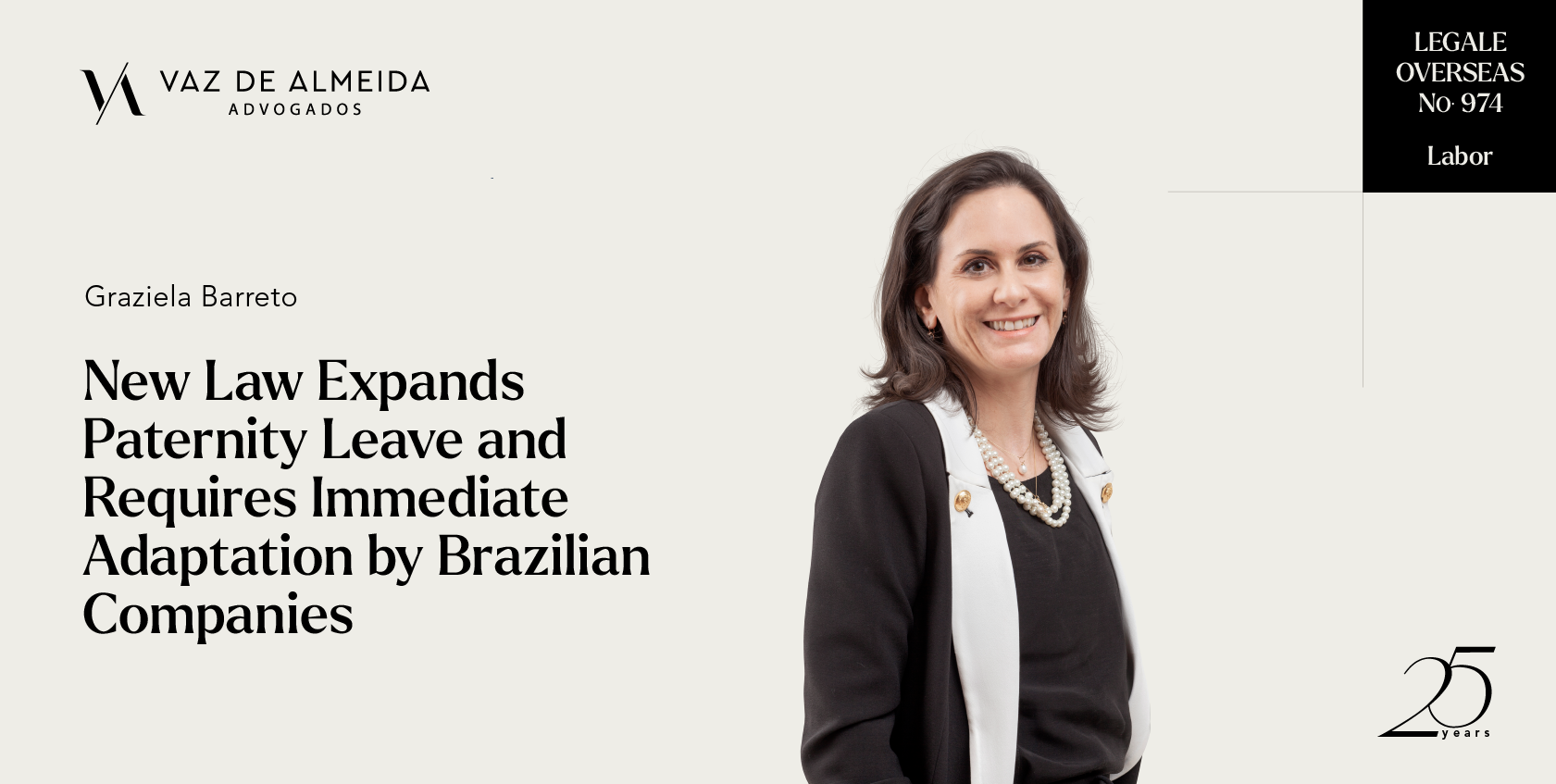
By Graziela Barreto
Legale Overseas, no. 974.
The law regulating and expanding paternity leave in Brazil was enacted on March 31, 2026, closing a regulatory gap that had existed since the promulgation of the Federal Constitution of 1988. The measure represents a significant step forward in parental policies and brings direct impacts for employers across the country.
Until then, paternity leave had been limited to five consecutive days, with the possibility of extension restricted to companies enrolled in the Citizen Company Program (Programa Empresa Cidadã). Under the new legislation, the benefit will be gradually and mandatorily expanded, covering all workers governed by labor laws.
The increase will occur in stages: as of January 1, 2027, paternity leave will be extended to ten days; in 2028, it will increase to fifteen days; and, from 2029 onwards, it will reach the definitive threshold of twenty days. Until then, the current five-day period remains in force.
The leave will be granted without prejudice to salary or employment status, covering cases of birth, adoption, or legal custody for adoption purposes. The expansion reinforces the father’s role in early childcare and contributes to a more balanced distribution of family responsibilities.
Another highlight of the new law is the creation of paternity pay, a social security benefit structured similarly to maternity pay. As a result, the cost of the leave will no longer be borne exclusively by employers, allowing compensation through the National Institute of Social Security (INSS). The measure also extends coverage to categories such as domestic workers, casual workers, individual microentrepreneurs (MEIs), and special insured workers. The amount varies according to the worker’s profile: full pay for employees; contribution-based for self-employed workers and MEIs; and equivalent to the minimum wage for special insured individuals.
The legislation also provides for provisional job protection, ensuring employment stability from the notification of birth, adoption, or custody through a period following the end of the leave. It further allows for extended leave in specific situations, such as hospitalization of the mother or newborn, the birth of a child with disabilities, or when the father assumes full responsibility for childcare.
For Brazilian companies, the change requires careful review of internal policies, regulations, and human resources procedures, as well as an assessment of impacts on collective agreements. Proper implementation of the new rules will be essential to ensure compliance and mitigate labor risks.
The expansion of paternity leave aligns with a broader trend toward valuing active parenthood and challenges organizations to adapt their practices to the new legal landscape.
The Labor and People Management team at Vaz de Almeida Advogados continuously monitors legislative developments, supporting companies in the safe and effective implementation of the new rules.
Translation Disclaimer
This document was originally drafted in Portuguese and subsequently translated into English using artificial intelligence (AI).
—
Follow us on LinkedIn >
People & Community >
Meet Our Leaders >
Awards, Seals, and Recognitions >
News: Quality Content on Our Portal >
—
Tax Law >
Corporate Law >
Automotive Sector Relations >
Conflict Prevention and Resolution >
Labor Relations, Global Mobility, and People Management >
Intellectual Property >
ESG, Environmental, and Sustainability >
Innovation, Digital Law, and Cybersecurity >
Infrastructure, Real Estate, and Construction Law >
Administrative, Public, and Regulatory Law >
—
Our publications aim to communicate the legal perspective on relevant developments and provide context to the most significant legal events that may affect companies and organizations. Specific cases require personalized technical attention to the facts and should seek customized legal advice before taking any legal or paralegal action. If you, your company, or your board of directors need counsel, contact a trusted attorney.
«Legale», «Legale Overseas», «Articles», «Especial», «Tax Panel», «Tax Alert», «Projects» e «News & Alerts» are periodic publications intended as a service to the business community. These materials may include links to third-party websites to facilitate access to referenced services and publications. However, we are not responsible for the integrity of third-party links, which may encounter issues such as server failures, network security vulnerabilities, or other accessibility problems.