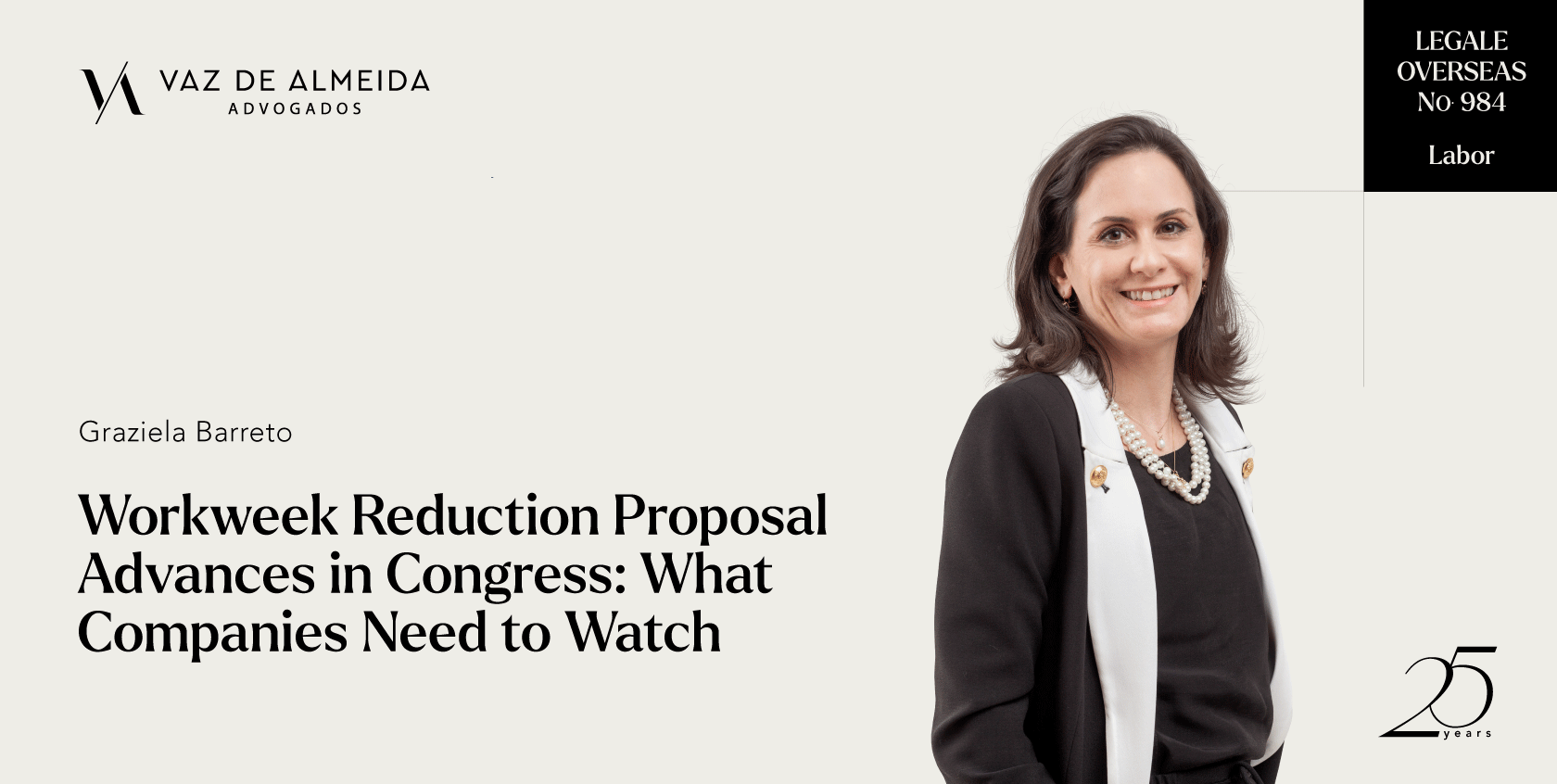
The proposal would reduce weekly working hours and may have significant implications for workforce management and operational planning.
By Graziela Barreto
Legale Overseas, no. 984.
The debate over reducing working hours in Brazil has gained momentum in 2026 amid broader discussions on ending the country’s traditional 6-on-1 work schedule. In this context, the Chamber of Deputies has approved, in two rounds of voting, a Proposed Constitutional Amendment (PEC) that would reduce the maximum workweek from 44 to 40 hours, expand the weekly rest period to two days, and maintain employees’ salaries. The proposal will now be reviewed by the Federal Senate, drawing increased attention from companies that may be affected by the potential changes.
Two Parallel Legislative Tracks
The discussion is progressing through two complementary channels. On one hand, the PEC would directly amend the Constitution and requires approval in two rounds of voting in both the Chamber of Deputies and the Federal Senate, without the need for presidential sanction. On the other hand, a Bill (PL) would regulate the matter at the statutory level, adapting labor legislation to the new framework and remaining subject to approval by the Executive Branch.
The simultaneous progression of these initiatives underscores the relevance of the issue and signals a broader trend toward changes in working-time regulations, albeit through different legal mechanisms.
What Is Being Discussed?
In practical terms, the model approved by the Chamber establishes a new working-time framework. The proposal provides for a reduction of the weekly limit to 40 hours, guarantees two paid days of weekly rest, and preserves employees’ salaries. It also maintains the possibility of collective bargaining, allowing companies and labor unions to tailor working-time arrangements to the specific needs of each sector.
How Could the Transition Take Place?
If the PEC is approved by the Senate without significant amendments, implementation is expected to occur gradually. Initially, the workweek would be reduced to 42 hours, accompanied by the adoption of a two-day weekly rest period. Subsequently, during the adaptation phase, working hours would be further reduced to the final threshold of 40 hours per week.
Impacts on Companies
Although no immediate legal effects have arisen yet, the progress of these proposals already calls for early assessment. Companies operating on a continuous basis or with high labor demands are likely to be more significantly affected and should begin evaluating potential adjustments to working-time structures, workforce allocation, and labor costs.
Issues such as time-bank management, collective bargaining strategies, review of third-party contracts, and financial planning are also becoming increasingly relevant. Taking a proactive approach may be essential to mitigating risks and ensuring a smoother transition should the changes ultimately be enacted.
Current Outlook
Discussions surrounding working-time arrangements remain ongoing and may influence how companies and employees organize their activities in the future.
Vaz de Almeida Advogados continues to monitor developments in this area and assess their potential legal and business implications across different sectors.
Translation Disclaimer
This document was originally drafted in Portuguese and subsequently translated into English using artificial intelligence (AI).
—
Follow us on LinkedIn >
People & Community >
Meet Our Leaders >
Awards, Seals, and Recognitions >
News: Quality Content on Our Portal >
—
Tax Law >
Corporate Law >
Automotive Sector Relations >
Conflict Prevention and Resolution >
Labor Relations, Global Mobility, and People Management >
Intellectual Property >
ESG, Environmental, and Sustainability >
Innovation, Digital Law, and Cybersecurity >
Infrastructure, Real Estate, and Construction Law >
Administrative, Public, and Regulatory Law >
—
Our publications aim to communicate the legal perspective on relevant developments and provide context to the most significant legal events that may affect companies and organizations. Specific cases require personalized technical attention to the facts and should seek customized legal advice before taking any legal or paralegal action. If you, your company, or your board of directors need counsel, contact a trusted attorney.
«Legale» and «Legale Overseas» are periodic publications intended as a service to the business community. These materials may include links to third-party websites to facilitate access to referenced services and publications. However, we are not responsible for the integrity of third-party links, which may encounter issues such as server failures, network security vulnerabilities, or other accessibility problems.