New rules affect cash flow, credit utilization and the tax routine of companies.
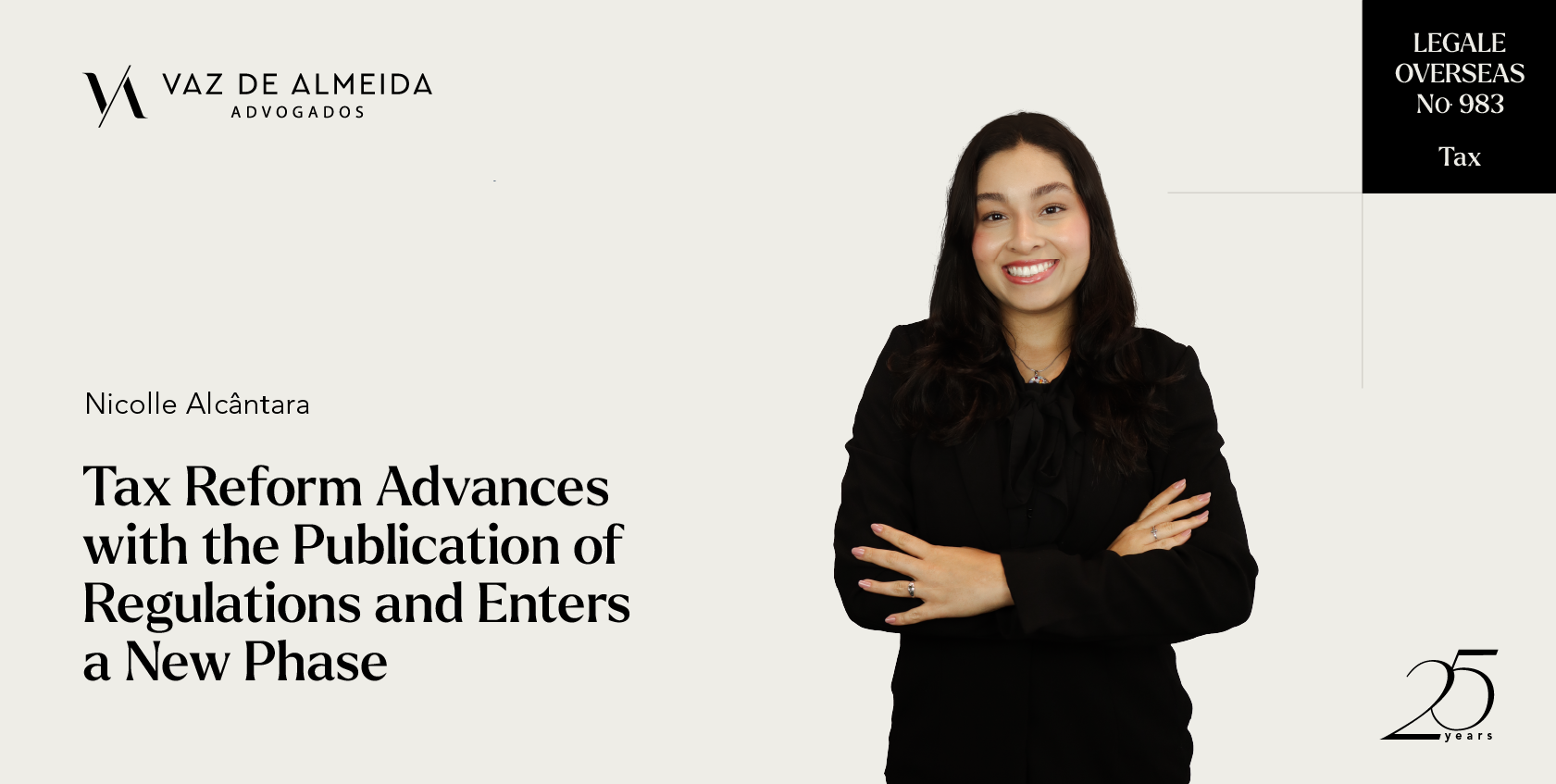
By Nicolle Alcântara
Legale Overseas, no. 983.
On April 30, 2026, the regulations for the Tax on Goods and Services (IBS) and the Contribution on Goods and Services (CBS) were published, marking a decisive step in Brazil’s Tax Reform. The documents detail procedures, operational criteria and forms of compliance with tax obligations, with a direct impact on the routines of the fiscal, accounting and financial departments of companies.
With the publication, some of the uncertainties associated with the legislation were reduced. Nevertheless, the length of the regulations, with more than 600 articles each, highlights the complexity of the new tax model, which was initially conceived with the goal of simplification.
On the operational side, the regulations establish closing dates for tax calculation, electronic tax documents, return and cancellation scenarios, correction of the Value Added Tax (IVA) debit amount and criteria for use and consumption transactions.
In this context, topics such as pricing, supply chains, operational structures and credit utilization now require more structured attention from taxpayers. It is worth noting that the applicable tax rate has not yet been announced.
Among the most notable new rules:
Ancillary obligations and tax documentation: the regulations provide for greater detail in tax documents and integration with electronic systems. This is likely to expand the automated cross-referencing of data by tax authorities and, consequently, the exposure to operational inconsistencies.
Market value for related-party transactions: these transactions, common in corporate group structures, will now be taxed based on market value, bringing IBS and CBS closer to transfer pricing concepts.
Split payment: the first phase of the mechanism has been regulated for payments via bank slip, PIX and electronic transfer. A subsequent phase will govern its application to card transactions. The model directly impacts cash flow and the timing of tax collection, requiring operational and systemic adjustments.
Credit utilization: the right to tax credits is now linked to the settlement of the debt from the previous transaction, whether through payment by the purchaser or through split payment mechanisms. It is no longer necessary to wait for the supplier’s actual tax remittance, which changes the traditional dynamic of credit management.
Several companies have already begun their preparation processes, working with clearer parameters to assess the adequacy of their systems and internal policies. For those that have not yet advanced on this agenda, the regulations reinforce the need to begin, with greater objectivity, the review of the guidelines that will govern the new model.
Vaz de Almeida Advogados has solid experience in Tax Law and closely follows the developments of the Tax Reform, acting strategically in the interpretation and implementation of the changes.
Translation Disclaimer
This document was originally drafted in Portuguese and subsequently translated into English using artificial intelligence (AI).
—
Follow us on LinkedIn >
People & Community >
Meet Our Leaders >
Awards, Seals, and Recognitions >
News: Quality Content on Our Portal >
—
Tax Law >
Corporate Law >
Automotive Sector Relations >
Conflict Prevention and Resolution >
Labor Relations, Global Mobility, and People Management >
Intellectual Property >
ESG, Environmental, and Sustainability >
Innovation, Digital Law, and Cybersecurity >
Infrastructure, Real Estate, and Construction Law >
Administrative, Public, and Regulatory Law >
—
Our publications aim to communicate the legal perspective on relevant developments and provide context to the most significant legal events that may affect companies and organizations. Specific cases require personalized technical attention to the facts and should seek customized legal advice before taking any legal or paralegal action. If you, your company, or your board of directors need counsel, contact a trusted attorney.
«Legale» and «Legale Overseas» are periodic publications intended as a service to the business community. These materials may include links to third-party websites to facilitate access to referenced services and publications. However, we are not responsible for the integrity of third-party links, which may encounter issues such as server failures, network security vulnerabilities, or other accessibility problems.